An investigation into DraftKings reveals how artificial intelligence can predict which customers may generate the greatest gambling losses. The company disputes allegations of improper targeting, but the controversy raises urgent questions about consumer protection in the age of personalized algorithms.
A sports fan opens a gambling app after losing money on a game. Within hours, another promotional offer appears: a bonus, a free bet, or an incentive to deposit more money.
To the customer, it may look like a routine marketing message.
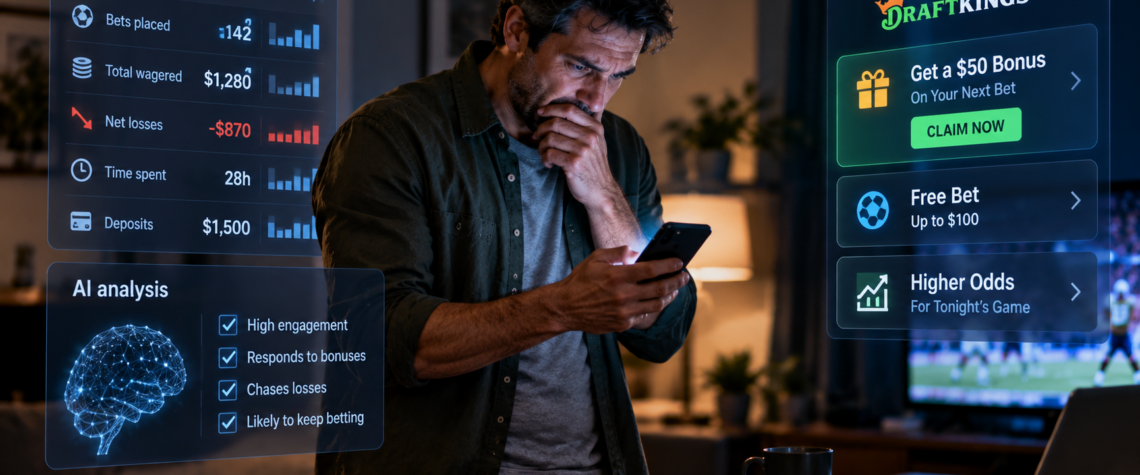
Behind the screen, however, sophisticated computer systems can analyze betting patterns, account balances, previous losses, and responses to earlier promotions. These systems can help companies predict which customers are most likely to keep gambling—and which promotional offers may generate additional revenue.
The technology raises an uncomfortable question: What happens when artificial intelligence becomes exceptionally good at predicting how much money a person is likely to lose?
A September 2026 investigation by The New York Times brought that question into sharp focus, examining how DraftKings, one of America’s largest online gambling companies, uses machine learning to personalize betting promotions.
The findings have since triggered legal challenges and renewed scrutiny of the relationship between artificial intelligence, gambling addiction, and corporate responsibility.
What the Investigation Revealed
On September 19, The New York Times published an investigation based on internal company documents, research presentations, betting records, and interviews with more than 40 former DraftKings employees.
According to the report, DraftKings developed a machine-learning model in 2023 to help determine which online casino customers should receive promotional incentives.
The system analyzed numerous aspects of customer behavior, including betting frequency, account balances, and the proportion of money customers typically lost relative to their wagers.
It then estimated how responsive individual customers might be to promotional offers. The model assigned customers a score known internally as elasticity. In practical terms, a higher score indicated that promotional spending was expected to generate a greater financial return for the company.
Former employees told the newspaper that the system could direct more incentives toward customers expected to lose more money.
One former analyst, Jayden Butts, described his growing concern about the relationship between profitability and gambling addiction.
The underlying problem was straightforward: A customer who repeatedly responds to promotions by placing additional losing bets may be highly profitable for a gambling company. That same behavior may also signal financial distress or problematic gambling.
Those two possibilities are not identical. Losing money does not automatically mean someone has a gambling disorder. But the overlap creates a serious ethical dilemma when a company uses behavioral predictions to influence customers’ decisions.
DraftKings Disputes the Allegations
DraftKings strongly rejects the suggestion that it improperly targets vulnerable gamblers. In its response to The New York Times, the company said its promotional offers are directed toward customers demonstrating sustained engagement with its platform, rather than customers selected because of their losses.
The company also maintains that it monitors potentially risky gambling behavior and provides tools intended to help customers control their activity.
DraftKings chief executive Jason Robins publicly criticized the newspaper’s reporting in September, calling its characterization of the company’s practices false.
The distinction matters. The investigation describes models designed to improve the financial effectiveness of promotional incentives, supported by internal records and former employees’ accounts. DraftKings disputes the interpretation that those practices amount to targeting problem gamblers.
Neither the existence of a profitability model nor a customer’s gambling losses alone establishes that the customer has an addiction.
The central consumer-protection question is whether promotional systems can identify people whose betting behavior suggests vulnerability—and what safeguards prevent those systems from encouraging further losses.
How AI Learns Who Is Most Likely to Keep Betting
Machine learning is a form of artificial intelligence that identifies patterns in data and uses those patterns to make predictions.
Online gambling platforms generate enormous amounts of behavioral information.
They can record when customers log in, how frequently they place bets, the size of their wagers, the games they prefer, how much money they deposit, and how they respond to promotional offers.
An algorithm can analyze those variables to estimate which customers are likely to react to a particular incentive.
For example, a system might learn that some users return after receiving a deposit bonus, while others ignore similar promotions.
The company can then allocate its marketing budget toward customers whose predicted responses are most valuable.
This is a familiar strategy in digital commerce. Retailers, streaming platforms, and advertisers also use predictive models to personalize offers and encourage customer engagement. But gambling introduces a fundamental difference.
For many betting products, the operator earns money over time because customers collectively lose more than they win.
Encouraging additional spending therefore carries risks that differ from recommending a movie or offering a discount on groceries.
An algorithm optimized for revenue may identify precisely the behavioral patterns that responsible-gambling specialists regard as warning signs.
When a Bonus Becomes a Warning Sign
Gambling promotions often appear to offer something for nothing.
A customer may receive a free bet, a deposit match, or an enhanced payout opportunity.
But promotional incentives can have conditions, restrictions, and wagering requirements. Their purpose is generally to encourage additional activity.
For someone gambling occasionally within an affordable budget, an offer may be little more than an advertising message.
For someone struggling to stop, the same message can become a powerful trigger.
The New York Times described the experience of Bryan Biehl, a gambler who reported losing nearly $70,000 through online betting, including substantial losses at DraftKings.
According to the investigation, he received 40 promotional emails from DraftKings during a two-week period in December 2024, while he was dealing with gambling addiction.
DraftKings declined to comment on his individual account.
His experience illustrates a broader concern: Promotional systems may continue to encourage betting even when customers are experiencing serious financial or behavioral difficulties.
Whether an individual promotion causes additional gambling can be difficult to establish. But repeated incentives can create additional pressure for people trying to regain control.
The AI System That Could Have Protected Customers
Perhaps the most revealing aspect of the investigation was not simply how DraftKings used machine learning to improve promotions.
It was what former employees said happened when researchers attempted to use similar technology to identify customers at risk of gambling problems.
According to The New York Times, data scientist Nestor Hernandez began developing a predictive system in 2024 that could analyze betting records and identify patterns associated with risky behavior.
The proposed model considered indicators such as deposits, withdrawals, and attempts to recover previous losses through additional gambling.
Its purpose was to help the company intervene before customers experienced more serious problems.
Former employees told the newspaper that the project was ultimately discontinued.
DraftKings acknowledged deciding against predictive risk-scoring technology but said the approach lacked sufficient evidence of effectiveness.
The company maintains that its existing responsible-gambling procedures are more appropriate.
Those procedures include monitoring behavioral indicators, sending educational messages, providing cooling-off periods, and allowing customers to exclude themselves from gambling services.
DraftKings has also said it uses large language models to monitor communications with customer-service representatives for signs of distress.
The controversy highlights an important question for the entire industry: If artificial intelligence can predict which customers are most valuable to a gambling company, should companies also be expected to use comparable technology to identify customers who may need protection?
A Lawsuit Adds to the Pressure
The investigation has already had legal consequences. On September 30, 2026, a proposed class-action lawsuit was filed against DraftKings in Massachusetts.
The complaint alleges that the company used artificial intelligence to identify vulnerable gamblers and target them with incentives designed to encourage continued betting.
It also raises questions about whether customers were adequately informed about the use of automated profiling.
DraftKings denies the allegations.
In a statement reported by Boston public radio station WBUR, the company said it does not use artificial intelligence to target customers based on losses or indicators of problem gambling.
A lawsuit is not a finding of wrongdoing. The allegations must be evaluated through the legal process, and the company’s response deserves consideration.
Nevertheless, the case illustrates how algorithmic marketing practices may become a significant area of consumer-protection litigation.
The Regulatory Challenge
Online sports betting expanded rapidly in the United States after a 2018 Supreme Court decision allowed states to authorize sports wagering.
Today, gambling applications make it possible to place bets almost anywhere that state law permits, often within seconds.
This convenience has created new challenges for regulators. Traditional gambling oversight focused heavily on licensing, game integrity, financial controls, and responsible-gambling programs.
Artificial intelligence adds another dimension: the ability to personalize promotional pressure using detailed predictions about individual behavior.
Regulators must consider whether existing rules adequately address automated profiling, aggressive incentives, and the use of behavioral information.
In October 2026, ProPublica reported on proposed New York regulations intended to strengthen protections for online sports bettors.
The broader policy question extends beyond gambling: Should companies be permitted to use predictive systems to encourage purchases or financial decisions when those systems identify behavior associated with potential harm?
There is no simple answer. Personalized advertising is widespread, and not every use of customer data is abusive.
But the stakes increase when the product itself carries a recognized risk of addiction and financial loss.
How Consumers Can Protect Themselves
People who use online betting platforms should understand that promotional messages are not necessarily random.
Offers may be selected using information about previous activity, customer engagement, and predicted responses.
That means a personalized bonus should not be interpreted as a special opportunity or an indication that a customer is likely to win.
Consumers can take several practical precautions.
Treat bonuses as advertising. A free bet or deposit match is designed to encourage gambling activity, not to improve the customer’s long-term financial prospects.
Turn off promotional notifications. Email offers, text messages, and push notifications can create repeated opportunities to return to an application.
Set limits before gambling. Deposit limits, spending limits, and time restrictions may help reduce impulsive decisions.
Never chase losses. Attempting to recover lost money by increasing wagers can deepen financial difficulties.
Use exclusion tools when necessary. Gambling platforms and state regulators provide options for taking a break or excluding oneself from betting services.
For people who are struggling to control their gambling, the National Problem Gambling Helpline provides confidential support and referrals in the United States. Assistance is available by calling 1-800-MY-RESET.
Recognizing that a problem exists is more important than responding to another promotional offer.
The Bigger Question: Who Is AI Working For?
The DraftKings controversy is part of a much larger debate about artificial intelligence and consumer behavior.
The same technologies that can help businesses understand customers can also make it easier to influence their decisions.
A retailer can predict when someone is likely to make a purchase. A financial platform can estimate which customers may accept a costly product. A social media service can learn which content keeps people engaged.
In each case, the algorithm may be optimized to serve the company’s commercial interests.
That does not automatically make the technology harmful.
But problems arise when the interests of the company and the interests of the consumer move in opposite directions.
For gambling platforms, the tension is especially visible. A system that encourages more betting may increase revenue while exposing some customers to greater financial risk.
Artificial intelligence does not independently decide what constitutes responsible behavior. Its predictions and recommendations depend on the objectives, data, safeguards, and policies established by the organizations using it.
If a company rewards an algorithm for increasing customer spending, the system will generally search for ways to accomplish that goal.
Whether it also protects vulnerable customers depends on the rules and constraints built around it.
The Bottom Line
The investigation into DraftKings has revealed a troubling potential conflict between personalized marketing and consumer protection.
Former employees and internal documents described machine-learning systems intended to improve the profitability of gambling promotions. DraftKings disputes allegations that it improperly targets customers based on losses or gambling problems.
The resulting lawsuit and regulatory scrutiny will help determine whether existing consumer protections are sufficient.
But the larger issue is already clear.
Artificial intelligence gives businesses an extraordinary ability to predict human behavior. That power can be used to improve services, reduce risks, and protect customers.
It can also be used to make commercial persuasion more precise.
The question is no longer simply whether AI can predict what consumers will do next.
It is who benefits from that prediction—and who bears the consequences when the algorithm is right.
Sources and Further Reading
- The New York Times, “How DraftKings Uses A.I. to Target the Gamblers Likeliest to Lose,” September 19, 2026.
- WBUR, “New Lawsuit Claims DraftKings Uses AI to Target Problem Gamblers,” October 1, 2026.
- ProPublica, reporting on proposed New York sports-betting regulations, October 2026.
- Vest v. DraftKings, Inc., proposed class-action complaint filed September 30, 2026.
- National Council on Problem Gambling, information on responsible gambling and support services.